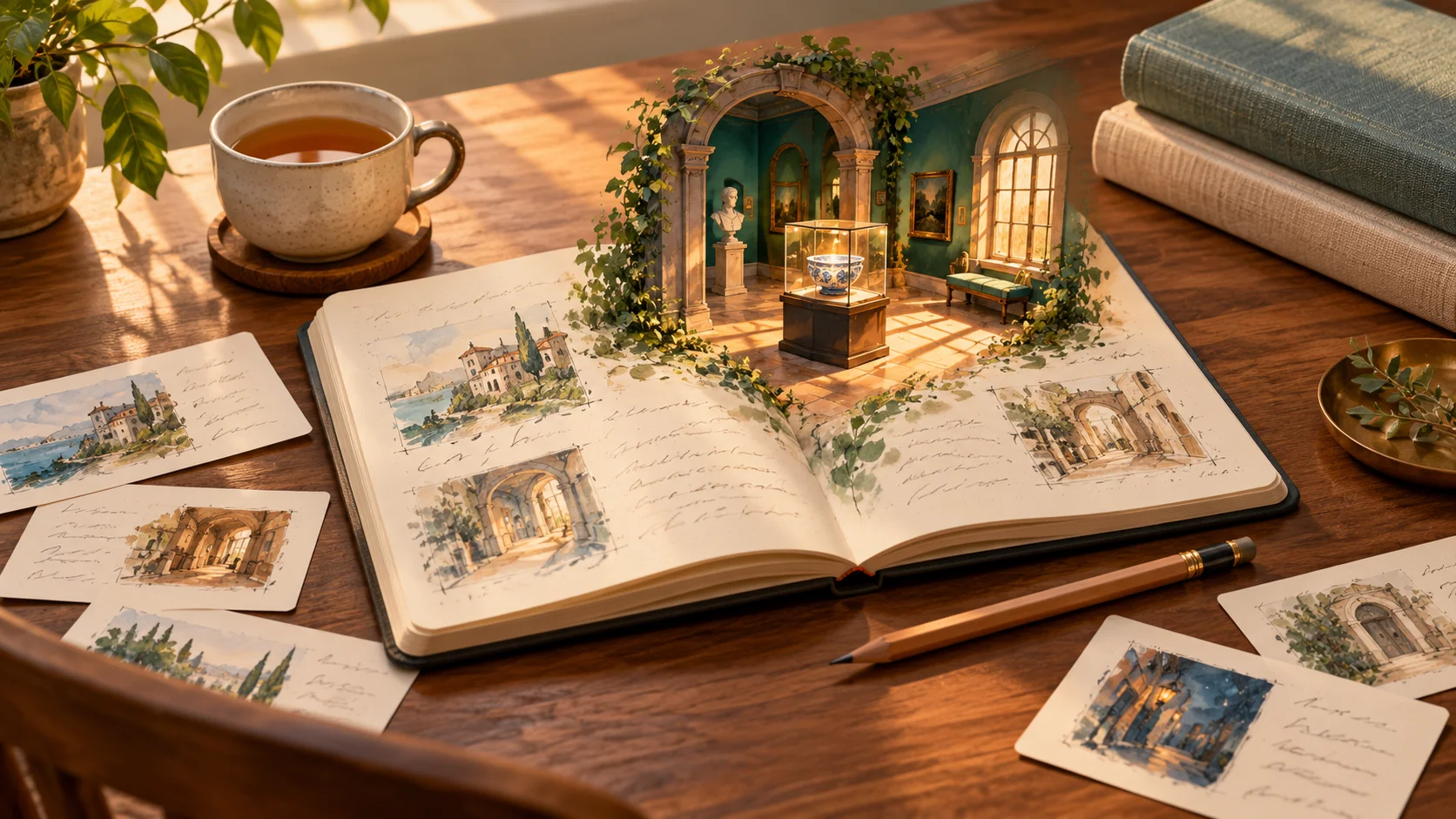
Use this free story outline template to plan a short story or novel, or to organize a draft you have already written.
Get the seven-page files and quick-start instructions on our free story outline template download page. Choose an editable Word document or fillable PDF, with no email signup. Then follow the guide below to connect your turning points, plan scenes, and build an outline using an original worked example.
Disclosure: This article contains Amazon affiliate links. As an Amazon Associate I earn from qualifying purchases, at no extra cost to you.

Key Takeaways
- Use an editable outline to connect a character’s goal, obstacles, choices, and consequences.
- Start with the smallest plan that makes the next writing task clear.
- Use the worked example and template to connect major turning points and individual scenes.
- Adjust the outline for a short story or novel and revise it as the draft develops.
Table of Contents
- Download the free story outline template
- A simple story outline template you can copy
- How to use the story outline template
- Story outline example with a complete arc
- Use the template for a short story
- Expand your novel outline chapter by chapter
- Adapt the outline to the story you want to tell
- Three books that help authors outline a novel
- Make a reverse outline when the manuscript has outgrown the plan
- Test a scene’s contribution before cutting or expanding it
- Story outline template FAQs
Download the free story outline template
Both versions are free and contain the same planning prompts and example. Use the PDF for brief answers or handwriting. Use Word when you want longer notes, additional scenes, or more rows.
Using Word: save a fresh copy for each story, replace the bracketed text with your notes, and duplicate the scene plan or add sequence rows as needed. The response areas expand as you type.
Using the PDF: download it and open it in a PDF reader that supports forms. Type into the fields and tick the review boxes, then save your working copy. Reopen the saved copy to check that your answers were retained. You can also print the blank pages and write by hand.
What’s inside the seven-page blank template:
- Page 1: story overview, including premise, goal, opposition, stakes, personal pressure, and a possible ending.
- Pages 2–3: eight turning point prompts, from opening pressure to aftermath.
- Page 4: a scene plan for goal, resistance, choice, result, and what follows.
- Page 5: a six-row scene sequence you can expand in Word.
- Page 6: The Missing Label, an original worked story outline.
- Page 7: a review checklist and a plan for your next writing session.
If you prefer Google Docs or another writing app, copy the compact outline below into a blank document. Start with a sentence or two per answer; you can add detail once you know which scenes you want to draft.
Jump to: Copyable outline · How to use it · Worked example · Short story outline · Chapter and scene plan · Books for outlining · FAQs
A simple story outline template you can copy
For a compact first pass, answer each line in a sentence or two. These prompts are a starting point you can adapt. They do not require eight chapters, a particular word count, or identical pacing for every story.
STORY OVERVIEW
Working title and genre:
Premise:
Protagonist and point of view:
Concrete goal and stakes:
Pressure and opposition:
Habit or belief under strain:
Possible ending and open questions:

PLOT DECISIONS
1. Opening pressure: What is already difficult?
2. Disruption: What changes the situation?
3. First consequential choice: What does the protagonist commit to?
4. Attempt and complication: What problem does the first approach create?
5. Changed understanding: What discovery changes the direction?
6. Costly setback: Why can the old approach no longer work?
7. Decisive action: What difficult choice resolves the central conflict?
8. Aftermath: What has changed, and what does that change mean?

SCENE FORM — repeat as needed
Chapter and scene number:
Viewpoint and setting:
Immediate goal:
Obstacle or resistance:
Choice or response:
Result and change:
Connection to the next scene:
Open questions or research:
A useful entry names an action or change. “The protagonist faces challenges” gives you little to draft. “She asks her supervisor to postpone the exhibition, and he removes her from the project” gives the next scene a reason to happen.
How to use the story outline template
1. Give the protagonist a concrete goal
Write a goal with an outcome the reader can recognize: win custody of a family shop, identify who altered an archive, or persuade a partner to stay. Then explain why this particular person cares. “Find happiness” may describe an emotional hope, but it does not yet tell you what the character will do on Tuesday morning.
Try this premise sentence: When [disruption] happens, [protagonist] tries to [goal], but [opposition] puts [specific stakes] at risk. Change the wording until it sounds like your story. The sentence is a planning aid, so it can reveal the ending or other information you would withhold in a book description.
2. Link the external problem to a personal difficulty
Give the protagonist a familiar response that makes the problem harder. Perhaps she avoids conflict, insists on working alone, or trusts a respected mentor too readily. Ask which choices would force her to reconsider that response. An internal arc becomes easier to plan when you can point to behavior that changes.
You can also write a protagonist whose values remain steady while the world challenges them. The template’s belief question is optional; it does not mean every character must repair a flaw. If motivation feels vague, our books for character development guide offers resources for that specific problem.
To develop the person making those decisions, use our guide to building characters for a novel and its free PDF worksheet. Work through the protagonist’s goal, motive, relationships, and scene response, then bring those choices back into your outline.
3. Sketch the turning points before counting chapters
Fill in the eight plot prompts with brief answers. If you know a vivid final confrontation but have no middle, work toward that ending. Ask what the character would need to learn, lose, or decide before the confrontation could happen. If the ending is uncertain, pencil in one possibility and label it provisional.
Look for connections between the answers. A discovery should change what someone does. A failed attempt should create a consequence or reveal why the next attempt needs to be different. Where two events feel unrelated, decide what information, motive, or pressure could connect them.
4. Turn each major development into scenes
A turning point may take several scenes to prepare. Separate the attempt, the resistance, and the consequence when each deserves space on the page. Use the scene form to identify the viewpoint character’s immediate goal and what changes by the end. A change can be emotional, practical, or relational; every scene does not need a dramatic twist.
Quiet scenes can carry substantial story work. A conversation in a kitchen might repair trust, plant a suspicion, or make a later refusal hurt. Write that purpose in the result field so the scene has a clear relationship to the rest of the novel.
5. Keep a note of unanswered questions
You may need to research a profession, decide how a fictional city works, or find a better reason for a character’s decision. Put those questions beside the relevant scene or in the “One detail I need to resolve” field instead of interrupting every planning session. Resolve the questions that affect the next scenes you intend to draft; leave less urgent details for later.
Set a practical stopping point: once you understand the opening situation and the next few scenes, try drafting them. Afterward, update the outline with what you discovered. Planning and writing can inform each other throughout the project.
If you have an outline but cannot begin the next scene, try our guide to overcoming writer’s block and the free two-page reset worksheet. Choose a small drafting task, test one character response, and leave a clear note for the next session.
Story outline example with a complete arc
Here is an original fictional example, The Missing Label, to show what completed answers can look like. It is a planning sketch for a mystery, so it reveals the solution.
Premise: Five days before her museum’s exhibition opens, collections assistant Inez notices that its centerpiece bowl does not match an old photograph. She wants to locate the original before a replica goes on display, but a powerful donor and her own unchecked paperwork threaten her investigation and her chance at a permanent job.
Personal difficulty: Inez treats her supervisor’s approval as proof that she has done good work. The investigation requires her to challenge him and admit a mistake she helped conceal.
| Plot prompt | What happens in this example |
|---|---|
| Opening pressure | Inez is finishing exhibition labels while hoping this project will earn her a permanent position. |
| Disruption | An older photograph shows a distinctive repair on the bowl. The object she is labeling has no repair. |
| First consequential choice | Her supervisor dismisses the mismatch. Inez decides to check the restoration records herself. |
| Attempt and complication | An invoice confirms that a replica was made. Her request for the shipping record alerts the donor, who demands that her access be suspended. |
| Changed understanding | A crate receipt shows that the original left the museum for the donor’s private collection. The donor arranged a false inventory entry to hide the transfer. |
| Costly setback | Inez realizes she signed off on that entry without checking it. Her supervisor offers to protect her job if she lets the exhibition proceed. |
| Decisive action | Using the photograph, invoice, and crate receipt gathered earlier, Inez reports the transfer to the museum’s governing board and acknowledges her own error. The board halts the display and secures the original’s return. |
| Aftermath | The revised exhibition explains the replica openly. Inez must rebuild trust, but she stops accepting approval as a substitute for checking her work. |
Notice how the evidence is introduced before the decisive action. The ending uses work Inez has already done and costs her something personally. The outline also gives the middle a direction: each new piece of information makes it harder to keep the problem quiet.
Use the template for a short story
For a short story, start with one central conflict and one consequential decision. Decide what the protagonist wants now, what stands in the way, and what will be different by the final paragraph. Fill in the overview before deciding how many scenes the story needs.
Several turning points can happen within a single scene. A conversation might reveal new information, close off an easy solution, and force the protagonist to act. You do not need a separate scene or chapter for every prompt.
To compress The Missing Label into a shorter story, you could begin with Inez comparing the photograph and bowl, combine the invoice and shipping discoveries in one records-room scene, then let her supervisor’s offer lead directly to her decision to report the evidence. The aftermath might be a brief image of her correcting the exhibition label. Keep enough evidence on the page for that decision to make sense.
A practical first outline can be three sentences: the problem, the choice that makes it harder or clearer, and the outcome. Expand only the scenes that need preparation. If a subplot creates a second conflict you cannot resolve within the story’s scope, save it for another piece or rethink its role.
If you prefer discovering the story as you write, fill in the next scene’s goal and possible result. After drafting, record what actually changed. The template can help you review a short story as well as plan one.
Expand your novel outline chapter by chapter
Once the major developments connect, group scenes into chapters. You might end a chapter after a consequential decision, a discovery, or a shift in a relationship. Some chapters will hold a single scene; others will need several. Let the material guide those divisions.
For example, the early investigation in The Missing Label could begin with these three scenes. Each one creates the next task:
- Scene 1, exhibition room: Inez wants to finish the centerpiece label. Comparing the bowl with an archived photograph reveals the missing repair. She decides to ask her supervisor, turning a routine task into a problem she cannot ignore.
- Scene 2, supervisor’s office: Inez wants permission to pause the label. Her supervisor insists the photograph must be wrong. She leaves without permission and chooses to check the restoration invoice, risking his trust.
- Scene 3, records desk: Inez wants to confirm whether the bowl was repaired. The invoice instead lists a commissioned replica. She requests the shipping record, which brings her inquiry to the donor’s attention.
You could place the first two scenes in one chapter and open the next chapter at the records desk. That is a pacing choice, rather than a requirement of the template. Temporary labels such as “photo mismatch” or “invoice discovery” make scenes easy to move before you commit to chapter numbers.
For a novel with multiple viewpoints, add each viewpoint to the scene form. Track who knows each important fact and when they learn it. This is especially useful when a scene’s suspense depends on one character withholding information from another.
Adapt the outline to the story you want to tell
Keep the fields that help you make decisions and add the ones your genre needs. In a romance, track how each encounter changes the relationship, alongside the external plot. Our books for writing romance novels guide can help you explore that relationship structure. For more detailed romance planning, our paid Romance Plotting and Revision Kit adds worksheets for both leads, relationship changes, and revision, plus an editable Excel scene tracker.
For fantasy or science fiction, add a note when a setting rule limits a character’s options. If a spell cannot cross running water, identify the scene where that limitation changes the plan. Our worldbuilding book recommendations focus on developing settings you can use in the story.
For a mystery, track the clue, its first interpretation, and what it eventually means. For an experimental or nonlinear novel, separate the order events happen from the order the reader encounters them. You can change the template’s sequence while retaining a clear account of what causes what.
For advice on dialogue, prose, character, and revision as well as plotting, see our guide to the best books about fiction writing. Choose a resource for the problem you want to solve, then return to the next scene.
Three books that help authors outline a novel
If you are looking for the best books on plotting a novel, choose a guide that addresses the part of planning you find difficult. These three options cover outlining methods, plot problems, and a more defined beat structure. You can use the free template without buying a book; one well-chosen guide is plenty to begin with.
Book coverage below is based on the linked author and publisher descriptions. The suggestions explain how each resource could fit your planning process.
Outlining Your Novel by K. M. Weiland
Choose this for: learning how to build and use an outline. Outlining Your Novel: Map Your Way to Success focuses on outlining approaches and connecting preparation with plot and characters. It is the most direct topic match here if your question is how to organize a story before drafting.
For this template, begin with the story overview, then use the guide to explore unanswered questions before expanding your scenes. This is a prose guide; the companion Outlining Your Novel Workbook is a separate title. Pick the guide if you want explanation before additional exercises. See the author’s description of the book.
Plot & Structure by James Scott Bell
Choose this for: an outline whose beginning works but whose middle loses direction. Bell’s Plot & Structure, in the Write Great Fiction series, covers beginnings, middles, endings, brainstorming, structural models, and correcting plot problems. It includes exercises and examples from novels.
Pair it with the attempt, complication, and setback prompts. Ask what your protagonist tries, what that attempt changes, and why another approach becomes necessary. This is a broader plotting resource, so it suits writers willing to diagnose a problem as well as fill in a plan. See the publisher’s description.
Save the Cat! Writes a Novel by Jessica Brody
Choose this for: a more defined structure to compare with your existing outline. Brody adapts the Save the Cat! approach for novelists, using 15 story beats and examples to explain how a plot develops. This is the novel-writing book by Jessica Brody, distinct from Blake Snyder’s original screenwriting guide.
After completing your first outline, use its framework to question missing developments or uneven pacing. If the framework starts making your characters behave implausibly, return to their motives and revise the plan. A defined structure is most useful when it helps you see a problem you can solve. See the publisher’s description.
Make a reverse outline when the manuscript has outgrown the plan
Summarize what the current draft actually does before repairing the original outline. Give each scene one row with its viewpoint, immediate goal, obstacle, decision, and result. Keep the description factual; “a powerful emotional moment” does not tell you what happens.
| Field | Useful entry | Unhelpful entry |
|---|---|---|
| Goal | Persuade the dispatcher to restore the cancelled route | Develop the protagonist |
| Decision | Offer evidence that exposes a friend’s mistake | Things become difficult |
| Result | The hearing is reopened, but the friend withdraws support | Build tension |
Those entries are an original teaching example. Use the same level of specificity with your own scenes. Compare the resulting rows with the outline’s major movements. You may discover that the draft found a stronger story, or that an intended turning point never reached the page.
Mark gaps without rewriting immediately: missing cause, repeated attempt, unexplained transition, or a decision that lacks preparation. Then choose the revision that connects the existing material most clearly. A reverse outline can reveal a structural problem that adding more future-plan detail would miss.
Test a scene’s contribution before cutting or expanding it
Ask what would become harder to understand if you removed the scene. The answer might involve information, a relationship change, an emotional consequence, or a necessary setup. A scene can matter even when it contains little external action.
- State the scene’s contribution in one sentence.
- Check whether another scene supplies the same contribution.
- Identify what changes between the opening and ending.
- Decide whether to retain, combine, move, shorten, or develop it.
- Recheck the scenes that depend on the change.
If two conversations both establish that a character distrusts the dispatcher, the second may need a new consequence rather than stronger wording. Perhaps distrust now causes the character to withhold evidence, changing the hearing. That gives the scene a distinct job.
For a quiet aftermath scene, the change may be a new interpretation or commitment. Make that movement visible enough that the next action follows from it. Do not cut every pause merely because the outline looks more dramatic without one.
Update the outline after the revision so it describes the manuscript you are working on. The template should remain a tool for making decisions, rather than a document you preserve after the story has moved elsewhere.
Story outline template FAQs
Is this story outline template free?
Yes. Both the editable Word template and fillable PDF are free to download, with no email signup. The outline, scene worksheets, worked example, and review checklist are included. Our separate Romance Plotting and Revision Kit is an optional paid resource for romance writers.
How long should a story outline be?
Use as much detail as you need to begin writing. A compact overview can establish the story’s direction; a scene outline can help when you need closer guidance. As a starting exercise, try one or two sentences per plot prompt, then expand the scenes you will draft next. There is no required outline length.
How many chapters should I plan?
There is no single chapter count for every novel. Plan the developments and scenes first, then group them according to pacing, viewpoint, and meaningful stopping points. The eight prompts in this template describe story functions, not eight mandatory chapters.
Can I use this story outline template in Google Docs?
Yes. Copy the outline text above into a blank Google Doc and type your answers beneath each prompt. The downloads are an editable Word document and a fillable PDF. The copyable version lets you start in Google Docs without a shared template link. You can also paste the prompts into the writing software you already use.
What if I prefer to discover the story while writing?
Use only the premise and the next scene’s goal, or complete the form after drafting a chapter. Recording what happened and what changed can help you see repetition or a missing consequence. Leave later developments open until you want more direction.
Can I change the outline during the first draft?
Yes. When you discover a stronger choice or a more believable consequence, revise the outline. Check which later scenes rely on the old version, especially clues, promises, timelines, and character knowledge. Updating those connections makes the new direction easier to follow.
What should I do after completing the template?
Choose the next scene you intend to write. Check its goal, obstacle, and result, then draft it. Keep the outline nearby and adjust it when the scene reveals something you did not expect. The useful measure of a planning session is whether it helps you move into the story. Once you have a revised draft, our free beta reader questionnaire can help you ask readers about pacing, confusing turns, and whether the ending feels earned.